Varo Bank: Online Banking
- 4.5
- Rating
- 5.00M
- Installs
- Free
- Price

 Analysis by App-foxy
I approached Varo Bank: Online Banking as something more demanding than a quick download. A finance app can feel impressive during its first few days, yet still become unnecessary once the initial curiosity fades. What matters here is whether it can make ordinary money tasks easier month after month, without turning every useful action into another chore.
Varo is a free mobile banking app from Varo Bank, N.A., aimed at people who want to manage banking from a phone and may also be interested in early-payday access or cash advances. It is available for Everyone, runs on operating system version 10 or later, and currently sits at version 4.24.0. The app has built a substantial audience, with more than five million installs, a 4.6 average from roughly 244 thousand ratings, and about 32 thousand written reviews.
Those figures suggest that the app is not merely a short-lived experiment, but they do not answer the more important question: will it deserve a permanent place on your phone? After spending time looking at how its purpose fits real routines, I think the answer depends heavily on whether you want a mobile-first banking relationship rather than a traditional bank with a mobile companion.
You May Also Like

 Blood Strike: 2.5 Anniversary
Blood Strike’s Loadouts Turn Every Drop Into a Tactical Gamble
A close look at Blood Strike’s custom loadouts: how fast access to signature weapons reshapes its battle royale rhythm, rewards preparation, and narrows the gap between fights.

 Pandora - Music & Podcasts
Pandora’s Music Is Easy to Start, but Harder to Recover
Pandora’s strength is its low-effort path from a seed to a station. Its weak spot is how much confidence it asks you to place in connection, setup, and quiet recovery.

 8 Ball Pool
 Is Built on Rivalries, Rematches, and Routine
A close look at the rivalries, rematches, shared routines, and unanswered safety questions that turn a quick pool match into a persistent mobile community.

 Samsung Music
’s Quiet Strength Is Playing What You Already Own
Its reach comes less from spectacle than from dependable access to a personal library. That simplicity is both the app’s strongest retention engine and its ceiling.

 AccuWeather: Weather Radar
AccuWeather Review: A Quick, Clear Forecast for Everyday Decisions
For everyday plans, the best forecast is the one you can understand quickly. AccuWeather makes rain timing, radar, and local conditions easy to act on, with a few trade-offs.

 Hill Climb Racing
Why Hill Climb Racing Still Turns Crashes Into One More Run
A tiny car, a bumpy hill and one more upgrade: Hill Climb Racing keeps resurfacing because its simple chaos makes every near-miss feel personal.
More From Our News Desk



What Varo feels like during the first week
The early appeal is easy to understand. A phone-based bank puts everyday account activity close at hand, which is useful when you want to check your balance, review recent movement, or deal with a payment without visiting a branch. The design goal is clearly convenience: banking is treated as an activity you perform in short sessions rather than a formal appointment.
The strongest first-week use case is a person who is trying to regain a clear view of their cash flow. Instead of waiting for a monthly statement or signing into a desktop website, you can make checking your account part of a normal phone habit. I find that especially helpful after a busy day of small purchases, when a quick review can show whether the week is still on track.
The early-payday positioning also gives the app a clear identity. For someone whose income timing creates a gap before regular payday, access to money earlier can feel more valuable than a long list of decorative banking tools. The same applies to cash advances: the attraction is not abstract financial technology, but the possibility of handling a short-term squeeze through the app.
That convenience needs to be judged carefully. Early access to money is not the same thing as earning more money, and a cash advance should not become a routine substitute for a workable budget. I would treat these options as emergency flexibility, not as part of my normal monthly income. The feature can solve a timing problem, but it cannot remove the underlying expense.
During the first week, I would also pay attention to how naturally the app fits your existing financial setup. A mobile bank is most useful when you know what role it will play. It can be a primary account for daily spending, a place to receive income, or a separate account for controlled expenses. If you download it without deciding that role, the app may become one more balance to monitor.
A practical first-week routine
My recommended starting point is deliberately modest. I would first learn where the balance, transaction history, and money-movement controls are located. Then I would make a small number of normal transactions rather than immediately moving every dollar into a new account. This gives you a chance to see whether the app’s presentation is comfortable and whether its timing suits your personal schedule.
One useful habit is to review the account after a recurring payment clears. That tells you more than a quick glance at the opening screen because it tests how easily you can connect an actual bill to your available cash. Another is to check the account after a weekend of spending. Those two moments reveal whether Varo helps you make decisions or merely displays information.
I would also decide in advance what would make me stop using the account. For example, if I found myself checking several banking apps just to understand where my money was, the convenience would be gone. Varo works best when it simplifies a financial routine, not when it adds another layer to an already scattered setup.
Why the value either grows or disappears after a month
After the novelty fades, the app has to earn its space through repetition. Its recurring value comes from reducing friction around common banking tasks and keeping money management available wherever you already use your phone. That is a stronger foundation than a one-time feature, because banking is naturally made up of repeated actions.
For a person paid on a regular schedule, the app can become a useful checkpoint between paydays. I would use it to look at what has arrived, what has already left, and whether an early-access option would genuinely help with a short gap. The important distinction is that the app can support a plan, but it does not create one. You still need to decide which expenses are essential and how much cash should remain untouched.
A realistic example would be a renter whose utility bill arrives several days before their next paycheck. If the rest of the month is already accounted for, early access or a cash advance may help bridge that timing issue. If the person is short every month, however, relying on the same option repeatedly could hide a structural problem. In that situation, a budgeting tool, a conversation with the provider, or a different banking arrangement may be more useful than another advance.
This is where Varo’s free price matters. There is less financial resistance to keeping the app available, especially for someone who wants a separate banking option without paying a subscription simply to maintain access. Still, free does not automatically mean effortless. Your time, attention, and the discipline required to monitor another account are also costs.
I see the app as more compelling for people who prefer managing finances independently from a phone. If you want a branch relationship, face-to-face explanations, or a broad package of services under one long-established institution, a conventional bank may feel more complete. Varo’s appeal is concentrated: it focuses on mobile banking and access to money, rather than trying to replace every possible financial relationship.
Where the app can become a lasting habit
The most durable workflow is to give Varo one clearly defined job. For example, you might use it for everyday spending while keeping long-term savings elsewhere, or use it as a dedicated account for bills. A defined purpose makes the transaction history easier to interpret and reduces the temptation to move money randomly between accounts.
Another useful approach is to make the app part of a weekly review rather than opening it constantly. A short review can cover the current balance, recent transactions, upcoming obligations, and whether any early-payday or advance option is truly necessary. This keeps the app connected to decisions instead of turning it into a source of anxious balance checking.
I would not build a financial plan around the most attention-grabbing part of the product. Early payday and cash advances are helpful precisely because they address occasional timing problems. If they become the reason you keep the app, the relationship may gradually shift from convenience to dependence. The long-term test is whether Varo helps you need those options less often.
The maintenance burden you should expect
Every banking app creates maintenance, even when the interface is simple. You have to keep track of the account’s role, review transactions, protect access to the phone, and make sure important payments are connected to the right place. Varo can make those tasks mobile, but it cannot make responsibility disappear.
The burden is relatively manageable when Varo is your main banking hub. You have fewer balances to reconcile, and the app becomes the obvious place to look. It becomes more tiring when you use it alongside several other accounts. In that case, a balance that looks healthy inside Varo may not represent your real spending position once other bills and transfers are included.
I would therefore avoid opening the account merely because the early-payday message sounds attractive. Before committing, I would write down which income and bills would actually pass through it. That small exercise prevents a common mistake: treating a new account as a solution before deciding what information it is supposed to organize.
Version 4.24.0 shows that the app is actively maintained as a current product, which is reassuring for anyone considering it as a regular banking tool. Even so, updates can change navigation and the location of familiar controls. I recommend checking the app after an update rather than assuming that a task you performed months ago still follows exactly the same path.
Security maintenance is another part of the bargain. I would keep the phone’s operating system current, use a strong device lock, and avoid treating notifications as a substitute for reviewing the full transaction history. The app can bring activity to your attention, but good account hygiene still depends on how carefully you respond.
Small decisions that reduce friction
A practical tip is to separate “checking the balance” from “deciding what the balance means.” The first is a glance; the second requires considering pending spending, scheduled bills, and money held elsewhere. If you only perform the first task, the app may give you confidence without giving you clarity.
I would also be cautious about using a cash advance for a purchase that can wait. The most defensible use is a short, identifiable timing gap with a clear way to return to normal afterward. If you cannot explain exactly how the next income event will cover the gap, the advance is probably postponing the decision rather than solving it.
Finally, I would review whether the account still has a distinct purpose every few months. If another bank has become your real primary account and Varo is only receiving occasional attention, keeping both may add more administration than value. A free account can still be the wrong account if it contributes confusion.
Where long-term fatigue can set in
The biggest source of fatigue is not the act of opening a banking app. It is the mental overhead of managing short-term access to money while trying to maintain a stable monthly plan. Features that feel reassuring during a tight week can become stressful if they encourage repeated decisions about whether to advance money again.
There is also a psychological trade-off in mobile-first banking. Immediate visibility can improve awareness, but it can also tempt you to check constantly. If every small purchase leads to another balance check, the app may become part of your financial anxiety rather than a tool for reducing it. I prefer a routine with defined review points, because the goal is control, not permanent monitoring.
Another limitation is that a focused mobile bank may not satisfy users who want a single place for every financial need. If your priorities include extensive in-person support, complex account structures, or a broad relationship with a traditional institution, the usual alternative may be better. Varo’s simplicity is an advantage for some people and a boundary for others.
People who already have a reliable emergency fund may also find the advance-oriented appeal less important. They might still appreciate mobile banking, but the feature that distinguishes Varo could have little practical effect on their lives. In that case, the best choice is whichever bank offers the clearest everyday experience and the least duplication.
I would also skip it if you are uncomfortable making important financial decisions through a phone. That is not a criticism of the app; it is a fit issue. A mobile-first service requires you to be comfortable with digital access, account review, and self-directed problem solving. Someone who wants a person to guide each step may be happier elsewhere.
How it compares with ordinary alternatives
Compared with a traditional bank’s mobile app, Varo feels more centered on phone-based access and short-term cash timing. A conventional bank may be preferable when branch support, a long-standing local relationship, or a wider set of financial services matters more than mobile convenience.
Compared with a budgeting app, Varo serves a different purpose. A budgeting app may help you see multiple accounts together or plan spending across categories, while Varo is itself a banking destination. I would not expect one to replace the other automatically. If your main problem is understanding spending across several institutions, a dedicated budgeting tool may add more value than opening another account.
Compared with simply using an existing checking account, Varo is most convincing when its mobile access or early-money options solve a specific problem. If your current bank already gives you a clear app, dependable access, and a comfortable payday schedule, switching may not improve enough of your routine to justify the change.
That comparison leads to a useful rule: choose Varo for a concrete workflow, not for the vague promise of having another financial app. The clearer the job, the easier it is to tell whether the product is helping after the first month.
My long-term verdict
I think Varo earns lasting space for users who want a free, phone-centered banking option and who can use early-payday or cash-advance access responsibly as occasional support. Its strongest quality is practical immediacy: it brings ordinary banking closer to the moments when people actually need to make decisions.
It is less convincing as a universal answer. Someone who needs branches, extensive financial services, or a single consolidated view of a complicated money life may prefer a traditional bank or a separate budgeting system. Someone who is regularly dependent on advances should also pause, because convenience can become a cycle if the underlying cash-flow problem remains.
My recommendation is to install it with a specific purpose, test that purpose through real bills and normal spending, and review the arrangement once the first-week excitement is gone. If the app helps you check money quickly, handle occasional timing pressure, and maintain a simple routine, it has genuine recurring value. If it merely creates another balance and another source of checking, the free download is not enough reason to keep it.
In the end, Varo Bank: Online Banking succeeds less through novelty than through repetition. The app is at its best when it quietly supports a sensible habit: know what is available, understand what is committed, and use short-term access only when the plan still works afterward. That makes it a worthwhile choice for the right mobile-first user, but not a replacement for financial judgment.
FAQs for Varo Bank: Online Banking
01What features does Varo Bank offer compared to traditional banks?
Varo Bank provides a fully digital banking experience with no physical branches. It offers features such as no monthly fees, early direct deposit, high-yield savings accounts, and access to a network of fee-free ATMs. Additionally, it includes financial tools like budgeting and savings trackers, making it ideal for tech-savvy users.
02Is my money safe with Varo Bank?
Yes, Varo Bank is a member of the FDIC, which means your deposits are insured up to $250,000 per depositor. The app also uses advanced encryption and security protocols to protect your financial information, ensuring your money and data remain secure at all times.
03Are there any fees associated with using Varo Bank?
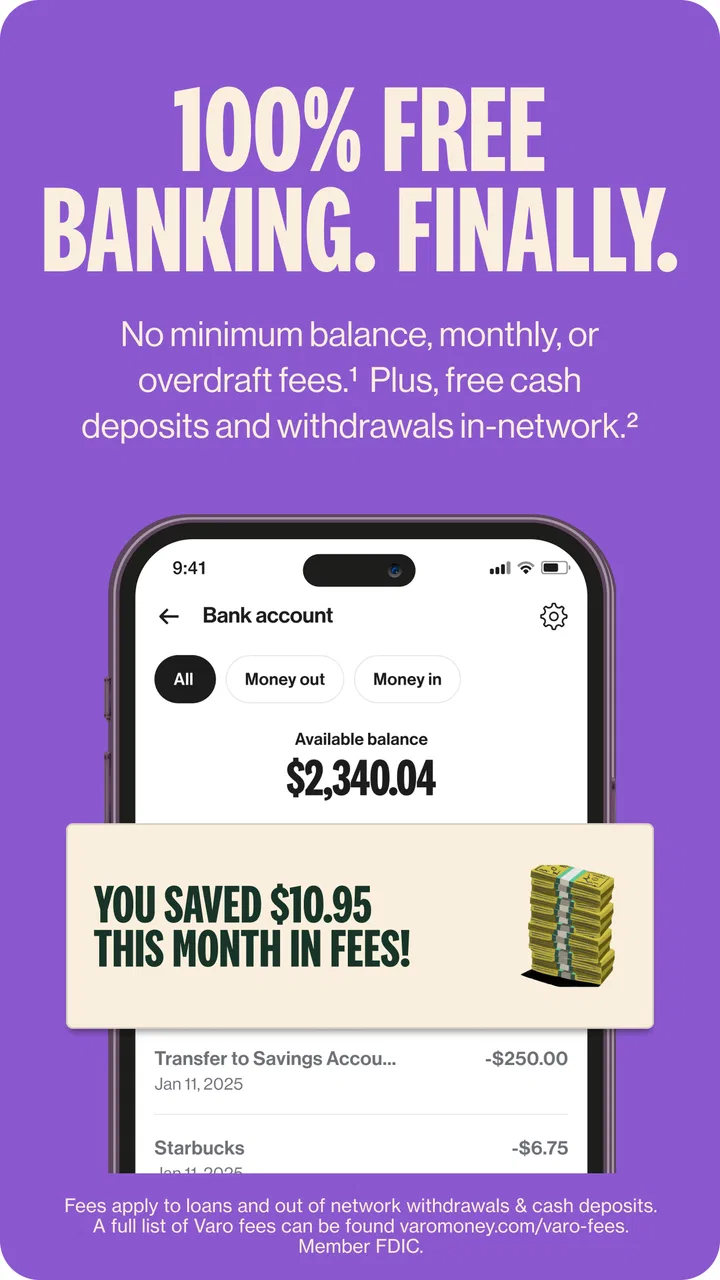
Varo Bank prides itself on being fee-free. It does not charge monthly maintenance fees, overdraft fees, or foreign transaction fees. However, there may be fees for certain out-of-network ATM withdrawals, so it's important to check the app for detailed information on ATM usage.
04Can I deposit cash or checks with Varo Bank?
While Varo Bank does not have physical branches, you can deposit checks through the app by taking a photo. Cash deposits can be made at participating Green Dot locations for a fee. This allows for flexibility without needing to visit a traditional bank.
05How does Varo Bank handle customer support?
Varo Bank offers customer support through multiple channels, including in-app chat, email, and phone support. The app provides a comprehensive help center with FAQs and guides, ensuring you can get assistance whenever needed. Customer service is available during extended hours for your convenience.
Pros
- No monthly fees for basic account use.
- Early direct deposit available.
- Large network of fee-free ATMs.
- User-friendly interface.
- FDIC insured for security.
Cons
- Limited cash deposit options.
- No physical branches available.
- Overdraft protection fees may apply.
- Some features require account upgrade.
- Limited international support.

Varo Bank: Online Banking
Gallery